Polarity and Divisiveness – how to stay in connection and come together across difference

Written by Moonwater, Executive Director and Ariel Brownstein, Communications Manager
On the heels of the November 4th elections, as well as Conflict Resolution Month in October, it is a particularly poignant moment to acknowledge the polarity and division we are each experiencing. Regardless of your worldview, your political leanings, or your personal beliefs, we are all being flooded with information, opinions, and often “us versus them” rhetoric.
Simultaneously, we are collectively struggling to find pathways forward through conflict that elevate and center our shared humanity. This same struggle is visible throughout our nation, here within our state, and throughout our county. This struggle manifests itself in our places of work, our schools, our local government, and our homes. It shows up when we stop listening to perspectives that differ from our own. It shows up when we choose violence or harm one another. It shows up when we shun and turn away from someone who sees the world differently.
So in the midst of the great divides of our time, how can we take concrete and actionable steps to bridge these chasms? How can we stand true in our own beliefs, while leaving the door open for connection with those who hold differing perspectives? How can we meet conflict with empathy and openness when it inevitably arises in our lives and relationships?
The Iceberg: From Positions to Interests
Conflict can often feel intractable when we see a clash in positions. These positions can appear as stances, demands, or opinions. When they differ from our own, arguments are quick to follow, emotions escalate, and relationships fracture.
In the world of creative conflict resolution we often draw upon the iceberg analogy to demonstrate the many layers beneath the position a person chooses to take. Above the surface of our iceberg we have tangible and identifiable issues – the “what”. These issues are well-recognized by the parties, and are central to the conflict at hand. They can be small and seemingly benign, such as a restaurant choice when negotiating dinner plans, or broad societal challenges such as housing. However, below the surface of the iceberg, we see that the bulk of the conflict is tied to interests. These interests are the driving motivations behind a person's position – their “why”.
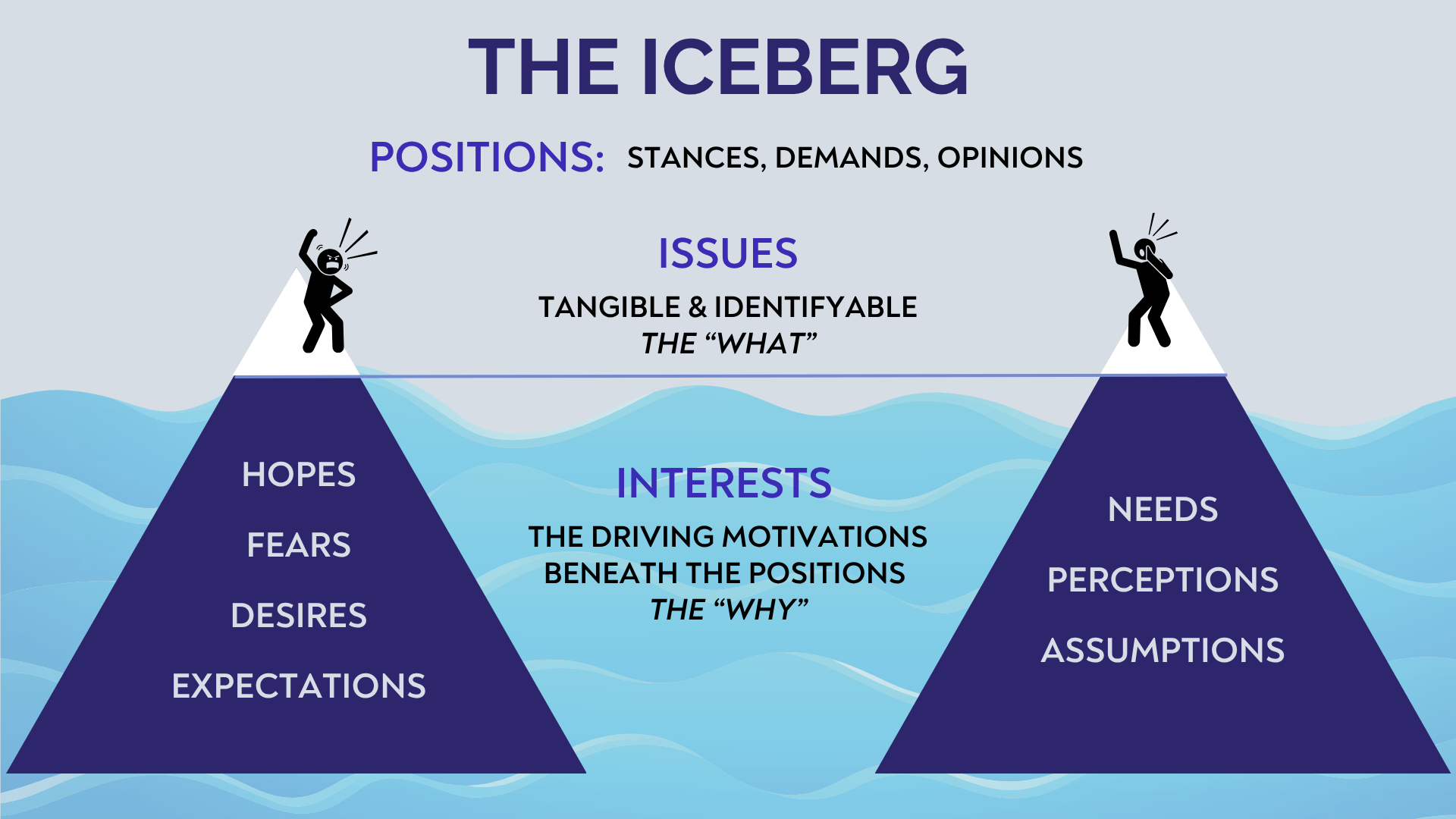
When we stay at the surface level, solely debating our positions on issues, we tend to get stuck trying to convince others of the merits of our own perspective. And we tend to stay stuck until we win or lose the argument. This cycle takes a toll, robs us of the ability to see other perspectives, and escalates most conflict.
Navigating Escalation and Anger
When individuals or groups lock into fixed positions and a conflict escalates, we often see anger come to the forefront. Exhibiting anger, much like taking a fixed position, signals that there is more beneath the surface to be addressed.
Anger as an emotion is not without purpose – it can highlight what is most important to us, and which of our values (such as respect, safety, or freedom) are worth protecting. However, anger is also a secondary emotion, and is often felt in response to a deeper core emotion. Hiding underneath anger we’ll find feelings such as sadness, confusion, worry, grief, regret, or misunderstanding. These feelings are directly linked to our needs, and when there is a threat to those needs (whether real or perceived), our primary feelings can quickly segue into anger.
If we notice someone else taking a fixed position or exuding anger, it's helpful for us to stay calm and curious, create some space, and come back to the conversation when tempers have cooled. And when we notice ourselves taking a strong stance and feeling anger, we can apply the same method - drawing on our own de-escalation skills to cool off. You can try going for a walk, listening to music, taking deep breaths, or taking a break from the situation, all while staying curious about what activated you, and what needs and interests are fueling your own positions.
So how can we move forward?
Both positional stances and anger can block us from engaging further, or productively, with one another. But there is another way. While it’s almost impossible to talk about the things we care about without letting our emotions influence us, if we let them take over completely, we lose the ability to listen well, to stay curious, and to understand.
Instead, when we can look beneath the positions and emotions of those we are in conflict with, we can make the space to listen and learn more about one another’s interests. When we are able to share our hopes, fears, desires, expectations, assumptions, perceptions, and needs, then we can stop operating in the binary space of “us versus them” and start working together to address the heart of the matter.
When you hear a strong position being shared, instead of reacting with one of your own, we encourage people to follow these steps:
1. Stay curious and listen to understand
2. Share your perspective
3. Identify the common ground
These first three steps enable us to stay connected across difference. Challenging our own assumptions and asking open ended questions, such as “ What experiences have shaped the perspective you are holding?” and “What values or needs are connected to that issue for you?” enable us to understand one another more deeply. In doing so, we often can identify where we may have commonality. Common ground is a powerful anchor for ongoing dialogue and connection.
If there is an actual conflict to be solved, you can continue on to:
4. Brainstorm solutions that meet everyone’s underlying interests
5. Choose an option and try it out.
These next steps create the opportunity to find true resolution based on what really matters. In doing so, the results create opportunities for durable paths of mutual gain.
The issues and divides we are all experiencing will not be solved easily, and will not be eradicated overnight. Yet none of us are served by division, and we all have something to gain by building understanding across differences. Instead of becoming overwhelmed by the immense scope of conflict in our world, try focusing on what is within your sphere of influence. How can you work to bring more empathy and understanding to that sphere? At home? In your workplace? Within your community groups? If we each make the effort to truly understand those with opposing viewpoints, we can person-by-person learn to stay in connection, find more common ground, and work together in a good way to resolve our conflicts.
Need help navigating a conflict?
The Whatcom Dispute Resolution Center is a 501(c)3 organization and exists to help our community navigate conflict in creative and constructive ways. We offer sliding scale services such as Mediation, Facilitation, and Conflict Resolution Trainings that can help you to move through difficult situations and strengthen your relationships. Learn more at whatcomdrc.org.